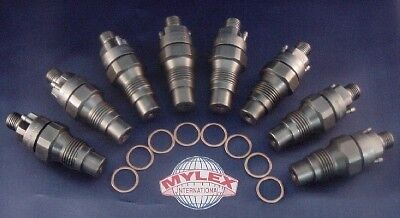
Pop pressure is uses to control duration. The injection pumps handles the fuel volume.
If you look at factory pop pressure is was raised for turbo and again for marine applications. This is because pump volume was increased for the turbo and marine 6.5s. With a Db2 you increase fueling by increasing the roller to roller clearance. This allows the roller to move father out and increase the fuel volume in the pumping chambers. But by doing so the roller will contact the camring lobe earlier thus advancing the start of injection and increasing the duration of fuel being injected. Pop pressure is raised to then bring the start of injection and duration back into spec. On some of the big DB2s its not uncommon to see 3k psi of pop pressure. On a dS4 the fueling is controlled a little differently but the same concept applies.
The added atomization from higher pop pressure really doesn't do anything for power in my option. Yes it makes an more complete burn. But The IDI is a 2 part combustion process. Fuel is atomized when it goes through the pressure differential created by the precup. The higher velocity swirl pushes all the fuel to the wall of the prechamber anyway. So the finer mist of fuel really isn't doing anything for the second part of the combustion process that occurs in the swirl bowl of the piston. That the part that matters the most since combustion pressure is needed to push on the piston.
By the book- I agree. That is how it is all supposed to work.
The problem I have - is we just played with it out of interest after having to swap turbo injectors into an n/a truck and instantly felt the difference. Then because mpg had been being recorded, we watched expecting to see worse mpg. It didn’t happen- it actually got better. Well, the first tank or so wasn’t- but the driver said because he felt the difference he was playing around more- spinning tire around corners, etc. But when he was used to it after a few hundred miles he started driving normal again.
So we did the same thing on another non turbo pickup- same results.
So then we started playing with it. Quickly the difference of balancing the injectors (we called it equalizing and we did it to 20 psi range because our gauge was every 10 psi) and that proved a no brainer. Honestly I couldn’t tell 20 vs 30, but 40 was noticeable without telling a driver. We would swap them out after being balanced and they would come back stating “something is wrong- it is shaking a little”.
So rather than confuse the narrative I just say 25 psi since that is where most the world seems to agree.
Is it better atomized? Idk. We tried bumping timing both db and ds pumps. Did not get the same effects. Atomized finer is just the best guess because it look that way when testing. Idk if closing the event window to a more compact time is what actually helps-
But if you set up a torch and test spray into the fire- you definitely see a difference in it.
So this is all why I am convinced it is atomizing better helping mpg and power.
Oh yeah, one engineer wasn’t convinced about the mpg, he thought the drivers were sneaking in a little fuel to skew the numbers just so they could have a truck that would finally do a lil burnout. Haha. So we put an engine on the dyno and a measured it. It wasn’t a great amount, but was there.