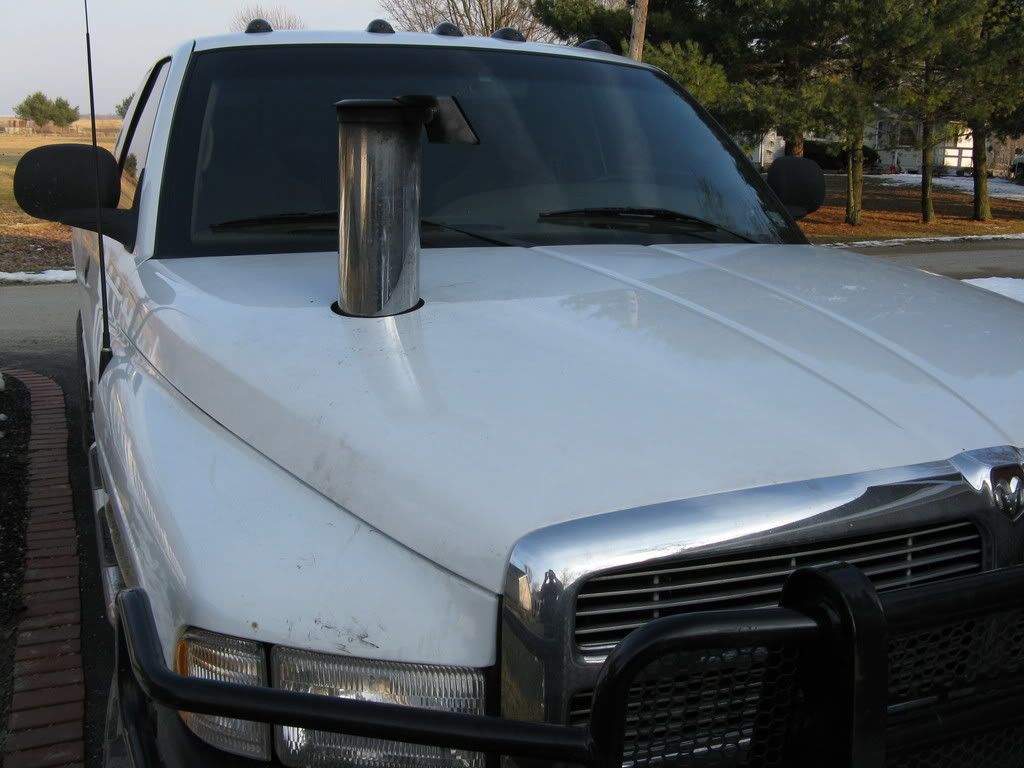
I think we mostly agree here, but your drawings have the pluses and minuses switched. Bernoulli's Law dictates that when the velocity of a flow decreases the pressure increases. Think of the windshield as an air dam. The flow of air over the hood pushes against the windshield and forces the air to slow down and increases its pressure. The high velocity air that flows up and over the windshield must necessarily be lower pressure. Using the snowflake example you used earlier, if the air close to the glass was lower pressure than the air flowing over the windshield the snowflakes would be pulled into the low pressure region and impact the glass. The fact that the snowflakes push away from the glass is further evidence that the pressure in that area is higher than in the high velocity flow region further away from the windshield. Another example is the effect of a large rock in the middle of a flowing stream. If you look closely you can actually see that the water level on the upstream side of the rock is higher than water that is flowing around either side. The flow of water is pushing against the rock and creating a high pressure zone which actually pushes the surface of the water upward.
Bernoulli's Priniciple can be observed clearly when there is in no laminar flow involved as in a simple Venturi flow meter (
VenturiFlow.htm), in an environment where the fluid is enclosed. In our case, there is laminar flow, and the fluid (air) is not enclosed. Again, the speed and shape of the vehicle have much to do with when laminar flow will form, and when and where high/low pressure zones occur.
What was not considered was that the air was already slowed down before it reached the hood:
-- the front of the vehicle slows and compresses the air (increase in pressure per Bernoulli) in front of it causing most of the air still coming towards the vehicle to separate and flow (now laminar) over/around the vehicle
-- the compressed air in front of the vehicle continues to flow over the hood (and the laminar airflow over it) where it begins to accelerate (decrease in pressure per Bernoulli)
-- the decompressed air decelerates as it approaches the windshield (increase in pressure per Bernoulli), creating another high pressure zone together with the eddy currents (the eddy currents form because of the large volume created between the laminar airflow and the hood's surface)
-- the compressed-again-air goes over the top of the vehicle, it accelerates (decrease in pressure per Bernoulli) towards the rear of the vehicle, etc.
-- all the while, the separated/laminar airflow does not touch the vehicle's surface...
The plus and minus signs were simply indicating where along the hood's surface the pressure goes from high and low.
In your example of a rock in the flowing stream, the water flows over the rock because of the water's momentum -- the water molecules bunch up and push upwards because they have nowhere else to go. Also, because of water's incompressibility (typical of almost all liquids), pressure differrentials in that situation are infinitessimal to the point that they are negligible.
Regards,
Franko