Hi all finally got the repaired IP back from Quadstar installed and running. They informed me the rotor was install backwards. Repaired it and resealed it and bench tested it.
I have the timing set at 3.5 and TDC Offset at -114. I tried a couple of times to get the Offset between-0.25 and 0.75 but couldn’t because it changed the timing setting above 3.5. i also did the Cleared and Learning TDC Offset using a 1997 timing procedure someone on here sent me and said it would be OK to use it on my 95’ OBD1 w/ my Tech2 .
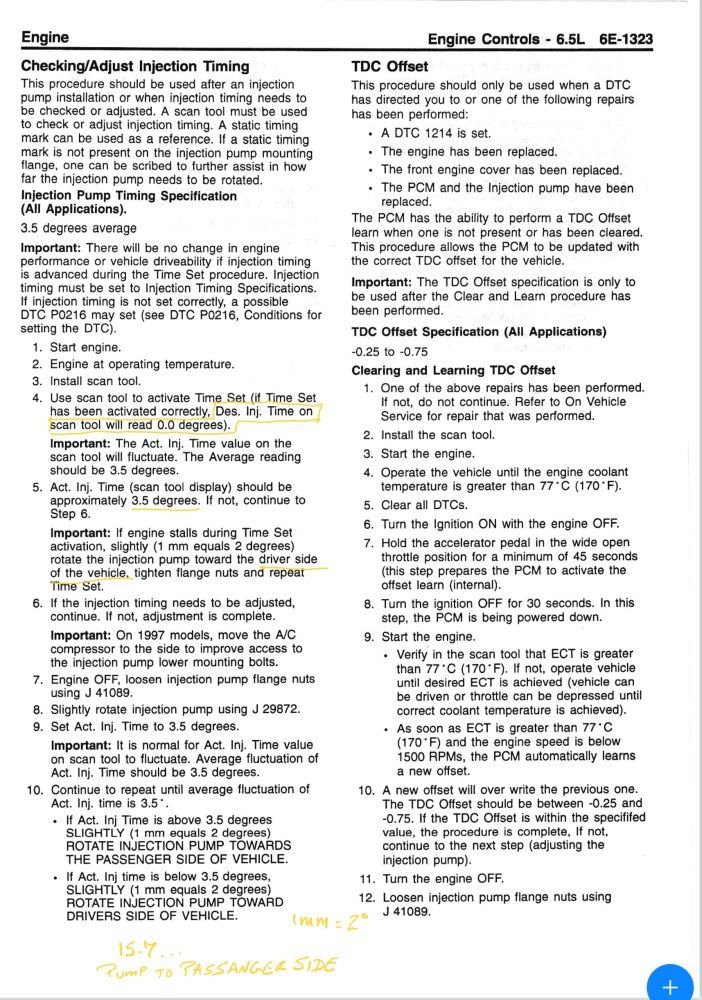
Here is another procedure I found should I use this one. This one is
entirely different.
I’ll post some scan tool data and get back to you guys. Probably w/more questions

I’m have some more questions on CDR outlet hose routings. But I’ll start a new thread this one is getting crowded w/ to many different subjects. Thanks guys.
OBD1 timing procedures for oem factory tune* - results may vary with aftermarket tunes
- Bill Heath's tunes respond normally with scantools (courtesy of member Turbovanman)
All DTC's must be cleared prior to performing Timing and TDCO procedures
To clear your OBD1 DTC's, put a wire jumper into pins A/B in the DLC connector under the dash, turn on the key, push brake and APP to the floor and hold for 1 minute or so. Turn off key, release pedals, then turn on key again. Should have cleared all codes, you should get a flashing 12. (courtesy of member JiFaire)
I compared procedures using a new TECH2 and GMTDScan Tech to find no difference, except that I prefer GMTDScan Tech as more user-friendly
Standard procedure
When installing a replacement DS4**, or resetting timing, start with the
Engine
Shut
Off solenoid in 90* vertical to horizontal plane across valve-covers - this should within a RCH of +3.5* Base timing
Start the engine, do an initial scan on engine parameters for 180*F ECT, idle speed 695~750rpm, ACTUAL IP timing +8.5*BTDC, DESIRED IP timing +8.5*BTDC, TDCO -0.5*
ECT must be at operating temperature ~180*F or timing procedures are invalid - I prefer 195*F
Scribe a line across the IP and timing cover flange
Scribe a second line across the timing cover flange, 2mm to the right of the first line - 1mm = 2.5*
Loosen the 3 12pt nuts on the IP flange, rotate the IP, aligning the IP flange line to the 2mm line for a +5* advance, secure the nuts
Start the engine, scan again verifying at least +180*F ECT, ACT\DES +8.5*, idle 695-750rpm
Command TIMESET, rpm will increase, engine will hesitate and stumble as PCM determines new IP position, wait ~5 seconds, exit TIMESET
Command TDCO LEARN, engine rpm will again increase, and hesitate\stumble, will self-exit when new value is learned
Scan again for +8.5*BTDC ACT\DES IP timing, TDCO at -1.5*
NOTE: engine stumble\hesitation is resulted during the period when PCM wratchets OS timing 22* between minimum and maximum limits to determine IP position
----------------------------------------------------------------------------------
If initial scanned TDCO value is elevated to some level greater than -0.5*, this may indicate BASE timing is not +3.5*BTDC
In this case Command TIMESET, exit; command TDCO LEARN, rescan TDCO - if same value, you will have to punt: either
- move IP to exacty vertical and do the standard setup
- or move IP 1mm to right, do TIMESET and TDCO LEARN, scan for new value
repeat at smaller increments until desired TDCO value is attained - PCM will DTC for TDCO over-range at some value greater than -2.02* for OBD1
*Again, aftermarket tunes seldom comply, but TDCO values at idle always represent Base timing, if you interpolate after the initial scan:
-0.5* = +3.5*
-1.5* = +8.5*
----------------------------------------------------------------------------------------
** Alternately, having scribed the line across the IP\timing cover, remove the old IP, accurately measure the position of the scribed line to either end of the upper slot - transfer that dimension to the replacement IP, scribe a line, match that line to the timing cover line when installing the IP, and you should be within a RCH of the original timing, no timing procedures necessary - the IP machining tolerances are that close