MID COURSE CORRECTION
Over he weekend I got some good work done and all the pistons ready to go in.
The pistons were a low mile set from a warranty engine from a GM shop.
Very low miles.
Well one piston had some scuffing on it at the area just under the crown.
Looks like maybe the engine may have ingested something ??
Not enough to really hurt anything buuuuuuuuuuuuut, enough to make me look at the part with a close eye.
Considering the long and convoluted mess that this thing has been, I dont want any issues.
Soooo I set about scrounging up another piston.
Some digging revealed that these pistons were early 6.5 stuff (92-93) and had the thinner crowns.
Hmmmm went back through my parts and discovered that the pistons that came from the original engine that was in DaHoooley (97 crate engine) were in great shape and the later, thicker head type.
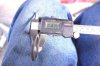
Sooooooooooo, I set about measuring all of them to verify sizes. I needed two pistons for cyls 7-8 that measured 4.0495 and the remainder needed to be 4.049
Since the block was honed to allow the use of the first set I did not wish to refit different sizes.
OOOOOK
I have two pistons that match up for cyls 7-8 and 5 that match up for 1-6
BUUUUUUUT there is one odd duck that is 4.055" diameter.
As these engines are all select fit its the luck of the draw when it comes to parts.
The pistons on these engines are all marked under the pin boss area with painted lettering.
JT is a production standard, KT is also a production standard but slightly larger followed by GT which is even larger.
The JT pistons can vary about
The one I have is an ST and its larger yet at about .005" over the standard.
JT Pistons measure at 4.049" to 4.050" This size is normally found.
KT Pistons measure at 4.050" to 4.051" This size will be seen.
GT Pistons measure at 4.0514" to 4.052"
I dont have a late enough GM manual to show the ST size but its definately a production size used in the select fit process.
My book is a 94 book and the ST piston came from an early 97 (first design squirt block)
The difference in the late and early pistons is very subtle.
Looking into the piston from the bottom the early ones have sort of a stair step look to them and the later ones are a curved underside without any steps in the area under the crown.
What this equates to is that the crown (Head) of the piston on the later engines is thicker to help stop cracking.
Early pistons were known to crack if the engine was run real hard with high EGT's
Soooooooo, no biggy here as this does not slow things down much, just have to clean these pistons up and then get them onto the rods.
The engine that was in DaHoooley when I bought it ran good and had low less than 100K miles and was nice, except for the cracked cyl walls.
These pistons should be fine.
Better to fix this stuff now rather than later.
I will try and snap a Piccy of the two different types of pistons and post it.
Also, keep in mind, if you are mixing and matching pistons to put an engine together.
Be sure all the pistons have the same Compression distance which is the distance from the top of the piston to the wrist pin C/L
GM did some fooling around with the compression ration in later years and dropped the comp ratio a tad.
SOOOOOOOOO, its easy to compare pistons.
Just pick one of your set and use a psiton pin to insert between two pistons and compare the tops to be sure they are equal.
If you find one or ??? that are higher or lower then you need to pay attention.
GM raied the pin height on some later pistons to drop the ratio a bit.
KEEP ALL PISTONS THE SAME.. have a set thats not all the same ratio would be a really bad idea as this would cause harmonics to develop that could over time casue sever damage.
The other issue would be an engine that was ROUGH running.
Having either ratio is fine, just dont mix and match.
All production pistons weigh the same, even oversized ones. This keeps things all in ballance using a stock crank.
Now if your doing a ballance job you can check this out and make any slight adjustments needed.
When assembling the engine the pistons should be flush with the deck to no more then .005" above the deck.
Anyway, so much for piston tech.
Missy