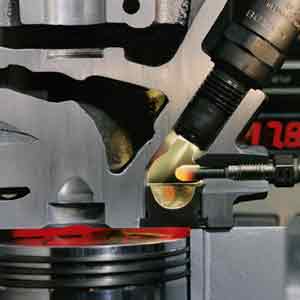
Two fundamentally different combustion systems are used today for diesel engines. One is the open-chamber or direct injection (DI) system and the other is the divided chamber or indirect injection system (IDI). In the DI system, high-pressure fuel (delivered by fuel injectors) is injected at the end of the compression stroke directly into the combustion chamber formed on the top of the piston. On the other hand, in the divided-chamber IDI combustion system, all the fuel is injected in a "pre-combustion" chamber or small cell that is in constant communication with the main combustion chamber. The cell contains only a fraction of the compressed air charge at firing time and, as a consequence, only part of the fuel injected burns in it. Subsequent to ignition, the resulting combustion drives the products of combustion and excess fuel through the transfer passage(s) into the main chamber with great energy in the form of temperature and velocity. Combustion is quickly completed in the main chamber with the aid of a high degree of turbulence.
During the last twenty-five years, great efforts have been directed with some degree of success towards applying the DI system to smaller passenger-car high-speed diesel engines. The DI combustion process, however, while currently being the optimum for larger truck diesel engines, suffers from various major technical difficulties in its applications to smaller, higher-speed passenger-car applications. The variable speed operation typical of passenger-car service, is one of the problems that is greatly aggravated by the fact that the engines must operate under strict emission-control regulations throughout a far-wider speed and load range. Although a handful of two-valve DI engines are in production for smaller vehicles, only one is in production for automobiles, namely, the 1.9 liter, four-cylinder, Volkswagen Golf and Jetta, TDI-series and its larger six cylinder brethren. The others are used in Europe for delivery vans and Sport Utility Vehicles.
The bulk of present research relative to small, high-speed automotive diesel engines is being conducted with four-valve systems and a centrally located fuel injector. Because of their small size, the new injection systems proposed for these small engines cannot generate the high pressures (up to 30,000 psi) of their larger diesel engine used for trucks. Even if it could generate the high pressures, it could not be used because the high pressures entail unacceptably small nozzle discharge orifices prone to coking. In view of the limited possibilities with the injection system and in order to increase the mixing at low engine speeds, a solution has been attempted by feeding each of the two intake valves via a different port, one directed and the other one helical. By de-activating the directed port at low engine speed, all the air enters through the helical port and generates maximum swirl, to improve the low-speed mixing and combustion. Then, for high-speed, both ports open for maximum air-flow and reduced swirl, more optimum to high-speed. This approach is not only expensive, but suffers because the swirl port always tends to reduce the air flow, so that, when both are open for high speed, the total flow is less than if both ports were of the directed type such as used with IDI engines. Moreover, these swirl-control systems are not either "on" or "off" and therefore continuously variable. As a result, although they satisfactorily improve combustion conditions on both the high-speed ranges and low-speed ranges, they do not do so in an optimized fashion throughout the total speed range. Generally, then, it could be said that the control logic, if anything, suffers a net loss.
In addition, small diesel engines show other problems which are mostly caused by the difficulties of properly combusting the fuel in the small chambers. These problems are explained in great detail in my Technical Papers Series 960058 and Series 960015, both presented on Feb. 26, 1996 at the SAE International Congress and Exposition, Detroit, Mich. The emissions problems are the worst, especially oxides of nitrogen (NOx), but also hydrocarbons, particulates, smoke and noise. All of these, as well as the power and fuel consumption, suffer greatly both by the very large proportion of inactive volumes distributed throughout the chamber in the form of crevices and by the sheer physical impossibility of properly timing the valve events without further increasing the crevice (inactive) volumes. The NOx problem, as on all engines, is a direct-function of the efficiency of the combustion process, which has already been characterized as high. The hydrocarbon, particulate and smoke problems are related to the quality of the mixing, the small size of the chamber, and the short real-time available to complete the combustion process. The problems also derive from the quality of injection; especially influenced by the so-called tail-ends of the injection process, but also affected by the physical impossibility of using the very high pressures of the larger truck engines. The problem with injection tail-ends is that the droplet size increases a uncontrollably after the injection-end signal is produced at the pump and the high-pressure fuel, trapped in the line-volume between the point where the signal is generated and the tip discharge holes, must be relieved through the discharge holes during a process of decaying-pressure. Complete combustion of this last fed portion of the injected fuel is impossible because (1) the fuel enters the chamber late during the combustion process when the amount of free-oxygen present has already been reduced by the prior combustion of the preceding main-fuel charge, and (2) the fuel is in the form of large droplets with low velocity that do not mix well and that do not have the time to evaporate and burn so late in the cycle. As a consequence, the fuel is not burnt and is exhausted as hydrocarbons, particulate and smoke. The smoke-limit, which controls the maximum power output, is reached at relatively high air-fuel ratios close to 25:1. In other words, the combustion process does not utilize all the air trapped in the chamber.
An additional problem with the DI combustion system is that of noise. The sudden and almost instantaneous ignition of a large volume of fuel in the main chamber results in a hammer-like high rate of pressure-rise (dubbed diesel-knock) which, apart from its chemical noise, resounds through the piston-rod and crank mechanisms plus the engine block and cylinder head, exciting them all into high-frequency mechanical vibrations. This characteristic is also closely-related to the typically-high firing pressures, which may exceed 2000 psi, forcing the use of heavier components, both movable and static. The heavier movable components, such as piston, rod, crankshaft and flywheel present other problems, because they consume more combustion energy to overcome their inertia during engine acceleration. This energy is later dissipated through the brakes during vehicle decelerations, thus wasting it and increasing the fuel consumption. This is not so much a problem for highway trucks, which move at fairly constant speeds, but is a major drawback of the typical variable-speed cycle of automobiles in city operation. The heavier shakier engine begets a heavier vehicle structure and suspension, and the heavier total mass of the engine and vehicle also reflect on the vehicle acceleration, fuel consumption and emissions on a variable-speed cycle.
Another problem with the DI combustion system, is the combustion noise during accelerations following idle periods as typically occurs during passenger-car city cycles. Although the part of this problem dependant on the acceleration of the heavier masses has been described above, it is aggravated by combustion-chamber thermal problems affecting the combustion-kinetics. In essence, the cooling of the chamber during the deceleration preceding an idle (a period during which the fuel is shut-off) and during the idle itself when little fuel is introduced, increase the ignition delay of the fuel, which is a time-temperature dependant process. Then, during the acceleration that follows, more fuel is injected into the cool chamber during its extended chemical-delay period than would be required with a warm chamber. As a result, when the auto-ignition temperature of the fuel is finally achieved, the sudden explosion of the artificially-larger fuel quantity releases more energy, producing a heavier diesel knock. The interesting thing is that the extra quantities of fuel injected during the extended period of ignition delay, contribute to a further extension of it, because the required heat of vaporization of the increased fuel quantity actually cools the air charge even more.
Turning now to the divided chamber IDI combustion system, the benefits and advantages of this type of system were obvious even before Dr. Diesel's time when it was proposed for other combustion systems. A workable design of a diesel pre-combustion chamber by Ricardo in 1919 was intended for large four-valve engines. The Ricardo pre-combustion chamber was located in the cylinder head, central to the cylinder main axis, and in between the four valves. It utilized only one interconnecting passage or throat to the main chamber. The throat was in the form of a venturi so as to reduce the pumping losses of the air charge entering the prechamber and the burning air and fuel charge exiting it, as well as to minimize by diffusion the torch-like effect of the flame impinging on the piston crown. The venturi-type Ricardo design clearly recognized that pre-combustion chambers incurred pressure and energy losses which, ultimately, reduced engine efficiency and required attention. The main purposes of the pre-combustion chambers was to accelerate the combustion process, and to tolerate the poor, erratic injection plumes produced by the low-pressure, hard-to-control, inefficient fuel injection systems of the times. In modern terminology, pre-combustion chambers opened the way for high power-density powerplants. Actually, they provided an escape-route to by-pass the then-unsolvable problems of open-chamber combustion such as the mixing and the requirements for fuel injection with precise injection timing and clean tail-ends.
The IDI process provided by Ricardo was characterized by faster combustion, enabling better air-utilization and higher engine speeds for more power through quicker ignition with lower rate-of-pressure rise and lower maximum firing pressure (both being more agreeable to simpler, lighter engine structures), as well as lower noise. At the time, emissions were of no concern, and fuel consumption was not an issue because the intent was to produce automotive-type (truck and bus) engines with which to replace the very-inefficient, large gasoline engines of the times. As a side benefit, it was also found that the IDI engines produced less smoke than comparatively larger DI engines, even while operating at up to three times the speed, with higher loads and at lower air-fuel (A/F) ratios. The same type of higher-speed IDI engines were also rapidly adapted to other uses, such as construction, marine, industrial and agricultural equipment, mainly by Caterpillar and International-Harvester in the US. In Europe, Franz Lang, the inventor of the plunger and barrel fuel injection system, also designed various pre-combustion chambers, the best known of which was the Lanova. The Lanova introduced Mack, Continental, White and others in the United States to the diesel world and was used until the 1960's. By 1934, a handful of automobiles were produced by the French firm Peugeot, powered by a four-cylinder 1750 cubic centimeters Ricardo-designed engine which was rapidly followed by Mercedes-Benz with its Model 260. All these engines, truck and automotive alike, used two valves per cylinder and side pre-combustion chambers. The Ricardo engines utilized their own pre-combustion chamber, trademarked "Comet", while the Mercedes units also used their proprietary design. Both pre-combustion chamber designs continue to this day, with some modifications.
During the last few years, some Ricardo "Comet" engines have been introduced with three valves, but still using an ancient-design side pre-combustion chamber. Four years ago, Mercedes also introduced an IDI, double overhead camshaft (DOHC), four-valve family of engines, with the pre-combustion chamber now centrally-located. So far, this is the only small four-valve, DOHC diesel engine in production worldwide.
IDI engines are fueled by self-cleaning, single-hole, pintle-type nozzles. The combustion process is too complex to be explained here, but my above-mentioned SAE technical paper No. 960058 describes it in more detail. In general, it is a two-step combustion process characterized by its speed and tolerance of fuel-system inconsistencies that allows operation of present automotive engines (such as the Mercedes IDI engine mentioned above) up to 5000 rpm. Combustion is faster and more complete than with DI systems, with more of the fuel being consumed even with lower amounts of air per cycle (lower A/F ratio) at the same smoke level. Since no swirl is required in the main chamber, high-efficiency directed intake ports can be used instead of the helical ports employed by DI engines, and more air is processed to provide higher volumetric efficiency with smoke-limited A/F ratios of less than 20:1. The combination of higher volumetric efficiency, reduced port-pumping losses, higher engine speed and higher combustion efficiency at lower A/F ratios produce higher power; typically, 10-15% more power at the shaft for similar-displacement engines. The indicated cylinder power is even higher, but two factors contribute to high thermal losses, which are detrimental to power output and fuel consumption. The first is the pumping losses in and out of the pre-combustion chamber and the second is the heat losses through the pre-combustion chamber walls. The technical world has concluded that these problems are unsolvable for small engines, and interest in pre-combustion chamber combustion has been lost, in spite of the fact that the overwhelming majority of pre-combustion chamber combustion characteristics are, for small passenger cars, far superior to those of the DI system. The Ricardo side pre-combustion chamber has remained unchallenged, except by some modifications that other researchers have performed including some work that I have done, as described in my U.S. Pat. No. 5,417,189, issued May 23, 1995 and my aforementioned SAE technical paper No. 960058. The only new application of a pre-combustion chamber system combined with four valves can be found in the new Mercedes-Benz DOHC family. Even so, the pre-combustion chamber and injector tip in this DOHC family differ very little from the 1927 Mercedes-Benz designs. Therefore, to continue enjoying all the benefits of pre-combustion chamber engines, while improving the fuel consumption profile, it is important, amongst other measures, to minimize the two main sources of losses; that is, pumping and thermal as exhibited by the current Ricardo and Mercedes designs. In reality, it is not required that they be eliminated completely. The reason being, as already explained, that the energy released by combustion is far higher than that of the DI system due to the more efficient burn. Therefore, the IDI system can tolerate some losses and still be competitive with DI; however, both sources of heavy losses must be reduced.
Two-Cycle engines of various designs have been used for many years in the widest array of applications; from very small motorcycle engines of less than 50 cubic centimeters per cylinder to giant marine engines with cylinder displacements over one thousand liters. Typically, both the smaller and the larger engines have been of valve-less designs, utilizing various port configurations in the cylinder to affect the supply of air and exit of combustion products. The smaller gasoline engines, typically carburetted, have been used for motorcycles and small commercial applications. The large marine engines, also known as "Cathedral Type" (obviously because of their height), are diesels fueled by one or more injectors on each cylinder and burn on the open-chamber (DI) system. The cylinder scavenging and filling process, proceeds through a set of ports formed along a portion of the bottom of the cylinder, then flowing up to the top of the cylinder and, after combustion and expansion, exiting the cylinder through another set of ports formed along the remaining portion of the cylinder bottom. The "loop" formed by the gas motion within the cylinder gives the process its name ("loop scavenging"). Some intermediate-size designs have used opposed pistons with the two pistons operating against each other in the same cylinder; both connected to different crankshafts geared to each other and disposed at the top and bottom of the engines. Some of the engines operate only as spark-ignited gas versions, with the fuel gas admitted through the intake ports and the spark plugs replacing the fuel injectors.
Some smaller two-cycle engines use the unique Kadenacy Uniflow designs, with valves in the cylinder head and inlet ports around the full periphery of the cylinder at the piston's Bottom Dead Center position. In the US, typical examples of such engines were introduced by General Motors in the early 1930's and are now manufactured by Detroit Diesel Corporation for trucks, marine and industrial applications. Winton, in Cleveland (now General Motors Electromotive Division, in La Grange, Ill.) also introduced similar, but larger engines, for locomotive and other purposes. All these engines now use four valves in the head, and a vertically disposed, centrally located fuel injector for open-chamber, DI combustion. Mechanically driven, positive-displacement Roots blowers supply scavenging and combustion air either alone or in series with exhaust-driven turbochargers. Some other intermediate and large-size engines, such as those supplied by Cooper Energy Services and typically used for gas pipeline pumping stations, are of the valveless, loop-scavenged type, operating strictly as spark-ignited gas engines. Some of these spark-gas engines have resorted to the use of pre-combustion chambers to reduce their emissions levels. On these engines, the main charge of fuel gas is supplied to the main chamber through mechanically actuated gas valves. The pre-combustion chambered versions also receive a small amount of gas, individually injected directly into the pre-combustion chamber, to increase the pre-combustion chamber fuel/air ratio to mixtures richer than stoichiometric; altering the overall combustion process to reduce emissions, especially NOx. This broad explanation of combustion on the various types and sizes of two-cycle engines has been undertaken because the trend towards the use of pre-combustion chambers in these engines has already started, as explained above in the case of the Cooper engines. None of the other two-cycle designs referred to above use pre-combustion chambers, and to my knowledge have never used them; however, it is predicted that they will be forced to use them as tightened environmental regulations are introduced in the future.
Other four-cycle, four-valve American engines from Cooper Energy Services, as well as from Caterpillar and Waukesha have also used pre-combustion chambers for many years, some as pure IDI diesels; others as spark-ignited gas engines. The latter are very popular in environments where low emissions are already closely regulated. With the trend towards the use of pre-combustion chambers, it has been predicted that newer, more efficient pre-combustion chamber designs will be required to minimize the pre-combustion chamber heat losses through heat transfer.
The need to keep the pre-combustion chamber as hot as possible has been acknowledged from the earliest use of the Ricardo "Comet" pre-combustion chamber in 1929. In the "Comet" pre-combustion chamber, the lower inserted portion of the pre-combustion chamber, called the "cup", is made of exotic heat-resistant material such as Nimonic and is designed to maintain an insulating air gap between its sidewalls and the cavity bored inside the head so as to reduce the heat losses. However, with the "Comet" pre-combustion chamber, the upper cavity is typically machined in the structure of the cylinder head and is prone to crack because of the high thermal gradient between the hot inside of the pre-combustion chamber walls and the cooler outside walls exposed to the cooling media compounded by the rates of firing pressure and maximum firing pressures as the fuel is ignited. To avoid this problem the design uses a water jet, typically drilled across the head, between the two valve ports (these engines typically being two-valve engines), both to cool the bridge between the valves and to impinge on the pre-combustion chamber's upper cavity. The upper-half of the pre-combustion chamber, therefore, not only suffers from the normal heat losses through its walls made of parent material exposed to the cooling jacket, but also has to cope with water being impinged upon it to avoid cracking the wall. In the process, it loses a very considerable amount of heat energy.
Some engines, made by Isuzu and others in Japan over fifteen years ago, upgraded the material of the pre-combustion chamber "cup" from Nimonic to ceramics, which has a far lower heat transfer coefficient; however, the top half of the pre-combustion chamber was not changed and still suffered high heat losses. Developments under my direction, using the lower pre-combustion chamber cup from Isuzu engines on an experimental Chrysler engine, proved that the engine not only reduced its fuel consumption by 4-5%, started faster, and produced less noise, but that it also burned faster and cleaner, allowing the injection timing to be retarded for reduced NOx, as well as hydrocarbons, particulates and smoke. Recognizing the fact that the main losses were still through the upper-half of the pre-combustion chamber, my U.S. Pat. No. 5,417,189, issued May 23, 1995, describes a heat shield designed for disposition inside the upper pre-combustion chamber cavity. The heat shield is intended to minimize the high heat losses of the pre-combustion chamber at this location by increasing the total wall thickness and creating an insulating air gap between the shield and the parent-metal cavity. It has been calculated that such shield could improve the engine's fuel consumption another 7-8 percent and all the other combustion parameters as well, by reducing the heat losses.
In addition, SAE Technical Paper 960506 by Kawamura et.al., entitled "Combustion and Combustion Chamber For a Low Heat Rejection Engine", presented at the 1996 SAE International Congress and Exposition, in Detroit, Mich., covered a laboratory research on an IDI engine with fully-insulated cylinders and pre-combustion chambers and indicated that it could produce lower fuel consumption and emissions than a similar engine operating on the DI combustion principle in which the whole cylinder was fully-insulated. The pre-combustion chamber described and disclosed in this technical paper was far cruder than the one described in my U.S. Pat. No. 5,392,744, issued on Feb. 28, 1995 and entitled "Precombustion Chamber For a Double Overhead Camshaft Internal Combustion Engine". This is so because the described pre-combustion chamber's very large-diameter bottom end restricted the valve sizes and its transfer passages had larger flow losses and did not generate any organized swirl motion in the pre-combustion chamber. Nevertheless, the paper indicated that the engine still had low fuel consumption levels. In my mind, therefore, it can be assumed both theoretically and practically that a well designed, centrally located and properly insulated pre-combustion chamber can provide a small, four-valve, high-speed IDI engine with far superior overall operational characteristics than any comparable engine using the DI combustion system.
Accordingly, the present invention is directed to novel means of insulating pre-combustion chambers so as to reduce their heat losses and to extend the use of the improved pre-combustion chambers to different engines which use different fuel and valve train systems.
SUMMARY OF THE INVENTION
In one form of the present invention for use with a diesel or compression ignition engine, the insulating means applied to the pre-combustion chamber consists of a pair of separate thick insulation members sandwiched directly between the cylinder head and the pre-combustion chamber. One of the insulation members is cone-shaped and encircles most of the tapered pre-combustion chamber bottom portion. Both of the insulation members are encapsulated between the component masses of the cylinder head to prevent passage to the main combustion chamber of any pieces that may break-off from the insulation members during the life of the engine. The pre-combustion chamber includes an upper housing member and a lower housing member with the former being provided with an annular groove into which a two-piece insulation member has a portion located therein and cooperates with the cone-shaped insulation member surrounding the lower housing member for reducing heat loss from the pre-combustion chamber. The insulation members are encapsulated and retained within the cylinder head by the metallic body of the cylinder head.
In still another form of the present invention for use with a spark-ignition engine, the pre-combustion chamber also includes upper and lower housing members but, in this instance, is shown combined with a single insulation member although a pair of insulation members could be provided if desired. This form of pre-combustion chamber has the upper and lower housing members surrounded by the single insulation member and has the housing members and the insulation member located in a machined opening formed in the cylinder head. The pre-combustion chamber as well as the insulation member are retained within the cylinder head opening by a spark plug support member which is secured to the cylinder head.
In the first form mentioned above of the present invention, the insulating means applied to the particular pre-combustion chamber has various functions that are derived from the reduction of the heat losses. First, towards the end of the compression stroke, the compressed air transferred from the main combustion chamber to the pre-combustion chamber is at a higher temperature and has a higher energy level at the moment of fuel injection because the heat losses to the prechamber walls and the engine structure or cooling media outside of it, have been reduced by the insulation. Second, the pre-combustion chamber mass, having retained more heat from combustion during the preceding cycle, also contributes to increase the temperature and energy level of the air within it. The higher air temperature resulting from both effects reduces the ignition delay of the fuel, or time that it takes from the beginning of injection until the self-ignition temperature of the fuel is reached and combustion starts. Since fuel under most operating conditions of the engine continues to be injected through and past the ignition delay, any condition which reduces the ignition delay also reduces the quantity of fuel present in the chamber at the moment of ignition. Thus, upon ignition, less fuel burns simultaneously, releasing less instantaneous energy and producing less noise. The noise resulting from all the fuel that burns simultaneously under this condition, is commonly known as "Diesel Knock" or better known in more technical terms as "detonation". One reason to minimize the delay period is to minimize the noisy diesel knock. Quicker ignition and earlier combustion of the first-injected amount of fuel also contributes to faster combustion of the successive amounts of fuel injected into the pre-combustion chamber after ignition. This creates higher pressures within the pre-combustion chamber to force the contents of the pre-combustion chamber into the main combustion chamber at a faster rate, with higher temperature and in a higher state of energy. As a result, a faster rate of burn is activated in the main combustion chamber and produces a shorter burn overall. The insulation also controls the heat losses during the period of pre-combustion chamber combustion so that the products of complete or incomplete pre-combustion chamber combustion discharged to the main chamber do so even with higher energy levels in the form of temperature and velocity. Thus, further contributing to a faster, more complete combustion of the air in the main chamber with the raw fuel and partially burnt fuel exiting the pre-combustion chamber. This condition, by itself, should reduce the amount of exhaust smoke, which is typically considered as the limiting factor on engine power. Therefore, by using more of the air and fuel with less or equal smoke levels than obtained with a non-insulated pre-combustion chamber, the engine produces more power and improves the fuel economy. The insulated pre-combustion chamber also reduces heat rejection during the other phases of the combustion cycle such as intake and exhaust, to further improve engine efficiency. Therefore, by burning the fuel in a more efficient manner, it is possible to achieve the following improvements, either individually or in combination: increased power, lower fuel consumption, lower emissions and lower noise levels.