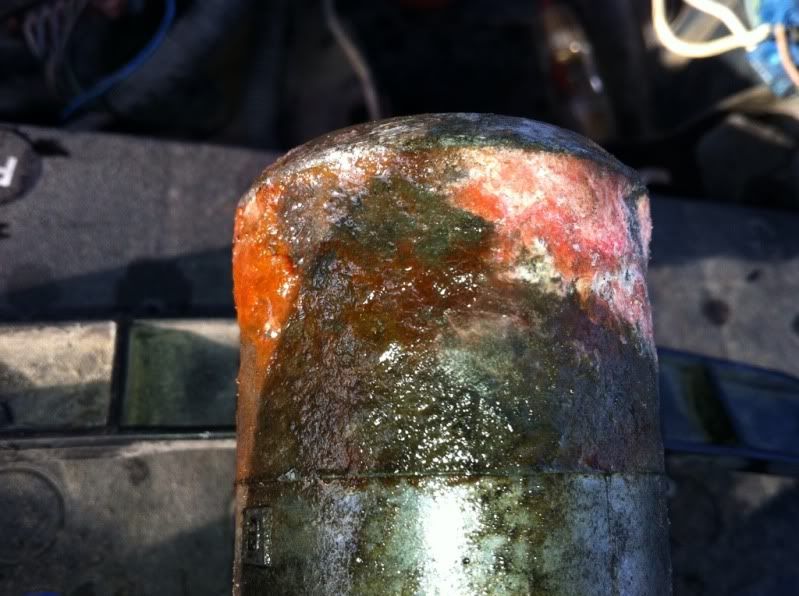
You should not generalize all DEX COOL together as there has been about 3 differrent versions of it that I know of. There was teh initail release in 96, a reforumulation around 98 or 99 after the initial problems, and another around 01 or so. Another HUGE problem with DEX COOL is it has the coolant sealant built into it and is activated by air. This is why GM went to the later closed cooling systems with a pressure tank instead of having teh conventional system with a coolant reservoir and a radiator cap. And up till about 00 the O-rings that were avaialble were not compatible with DEX-COOL even though GM specified they needed compatible O-rings. It was such a new product, that unfortunately the long term testing had to be done in the field by the consumer. I know I'm running DEX-COOL in my BURB, and so far it has been great. And most everybody with a DURAMAX has not had a single problem with corrosion, and this is in an engine with very disimliar metals in it. Unfortunately people are still stuck on the down sides of DEX-COOL from the late 90's, sort of like how everybody says a 6.5 is a crank breaking, injector pump eating boat anchor. it doesn't mean it's true, but people still say it.
I thought they specified DEX-COOL because it's low silicate or phosporous which is what's compatible with the cooling system?
Here's what Wikipedia had to say:
Organic acid technologyCertain cars are built with organic acid technology (OAT) antifreeze (e.g., DEX-COOL[15]), or with a hybrid organic acid technology (HOAT) formulation (e.g., Zerex G-05[16]), both of which are claimed to have an extended service life of five years or 240,000 km (150,000 mi).
DEX-COOL specifically has caused controversy. Litigation has linked it with intake manifold gasket failures in General Motors' (GM's) 3.1L and 3.4L engines, and with other failures in 3.8L and 4.3L engines. Class action lawsuits were registered in several states, and in Canada, to address some of these claims. The first of these to reach a decision was in Missouri where a settlement was announced early in December 2007.[17] Late in March 2008, GM agreed to compensate complainants in the remaining 49 states.[18] GM (Motors Liquidation Company) filed for bankruptcy in 2009, which tied up the outstanding claims until a court determines who gets paid.[19]
According to the DEX-COOL manufacturer, "mixing a 'green' [non-OAT] coolant with DEX-COOL reduces the batch's change interval to 2 years or 30,000 miles, but will otherwise cause no damage to the engine."[20] DEX-COOL antifreeze uses two inhibitors: sebacate and 2-EHA (2-ethylhexanoic acid), the latter which works well with the hard water found in the US, but is a plasticizer which can cause gaskets to leak.[14]
According to internal GM documents,[citation needed] the ultimate culprit appears to be operating vehicles for long periods of time with low coolant levels. The low coolant is caused by pressure caps that fail in the open position. (The new caps and recovery bottles were introduced at the same time as DEX-COOL). This exposes hot engine components to air and vapors, causing corrosion and contamination of the coolant with iron oxide particles, which in turn can aggravate the pressure cap problem as contamination holds the caps open permanently.[21]
Honda and Toyota's new extended life coolant use OAT with sebacate but without the 2-EHA. Some added phosphates provide protection while the OAT builds up.[14] Honda specifically excludes 2-EHA from their formulas.
Typically OAT antifreeze contains an orange dye to differentiate it from the conventional glycol-based coolants (green or yellow). Some of the newer OAT coolants claim to be compatible with all types of OAT and glycol-based coolants; these are typically green or yellow in color (for a table of colors, see [13])